Give a small brief explanation of all Elements in activity diagrams
Give a small brief explanation of all Elements in activity diagrams?
✍: Guest
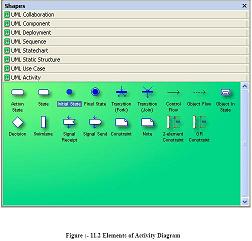
Action State : It is a type of state that has an internal action and one outgoing event that
would complete the internal action.
State : It is a condition when following events occur:
Object satisfies a condition.
performs a action.
wait for a event to happen.
Initial State: It represents a state before any event occurs.
Final State:
Represents completion of an activity.
Transition Fork:: Denotes beginning of parallel path activities.
Transition Join: Denotes merging of parallel path activities.
Control Flow: Represents relationship between two states and actions. In short it indicates
that an object in one state is entering some other state.
Object Flow: Connects an object flow state to control flow or action state.
Object in State: Indicate the object’s state after manipulation by multiple activities.
Decisions: Defines if there are any condition’s in the path.
Swim Lanes: Assigns responsibility to action states.
Signal receipt Shape: Used to replace an event label on a transition.
Signal Send Shape: Used to replace an event label on a transition.
Constraint: Conditions that must be maintained true in order the system is valid.
2-Element Constraint: - It show a constraint on two classes or associations.
OR constraint: - It show an OR constraint on two classes or associations.
2007-10-26, 6145👍, 0💬
Related Topics: