What Is a Client-Side Image Map
What Is a Client-Side Image Map? - XHTML 1.0 Tutorials - Understanding Inline Images and Image Maps
✍: FYIcenter.com
A client-side image map is an image defined with the "ismap" attribute and the "usemap" attribute. When a client-side image map is clicked in a browser window, the browser will take mouse coordinates and map them to a predefined image map entry, to retrieve a target URL. The browser will then redirects to that URL. Here are the rules about "ismap" and "usemap" attributes:
- ismap="ismap" - Specifies that the image is either a server-side image map or a client-side image map.
- usemap="#mapReference" - Specifies that the image is a client-side image map, and the map is defined at the specified map reference.
Here is a tutorial example of how to define a client-side image map:
<?xml version="1.0" ?>
<!DOCTYPE html PUBLIC "-//W3C//DTD XHTML 1.0 Strict//EN"
  "http://www.w3.org/TR/xhtml1/DTD/xhtml1-strict.dtd">
<html>
 <head>
  <title>Client-Side Image Map</title>
 </head>
 <body>
  <h4>Inline Images</h4>
  <p style="background-color: #eeeeee; padding: 8px;">
   This is a client-side image map test.
   Click this image <img src="/moonrise.jpg"" alt="Moonrise"
    width="69" height="91" ismap="ismap" usemap="#mymap"/>
   to see what happens. Use browser back button to come
   back.</p>
 </body>
</html>
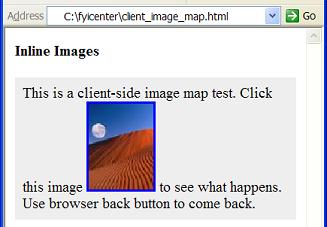
If you save the above document as client_image_map.html, and view it with
Internet Explorer, you will see an image. You can click it. But nothing will happen,
because there is no map entries defined.
2007-05-12, 5303👍, 0💬
Related Topics: